
Elementor #2983

b1

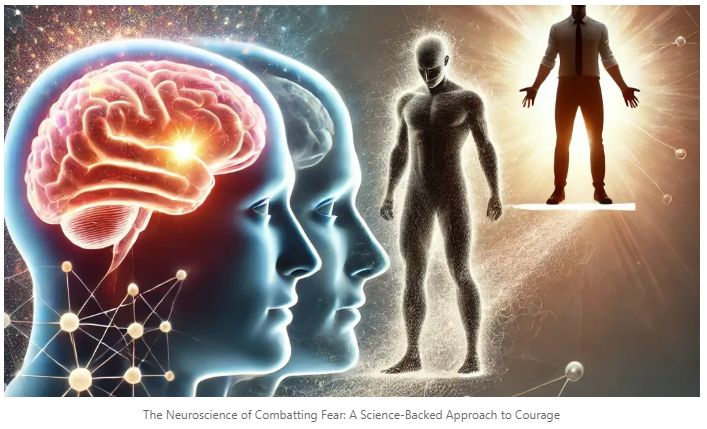
The Neuroscience of Combatting Fear: A Science-Backed Approach to Courage

Fear is an ancient survival mechanism deeply ingrained in our brains. While it once helped us escape predators, today, it often holds us back from personal and professional growth. Neuroscience reveals that fear is primarily governed by the amygdala, a small but powerful part of the brain responsible for processing emotions. Fortunately, we can rewire our response to fear using neuroplasticity—the brain’s ability to reorganize itself through repeated experiences.

Over the years, I have developed a four-step approach to combat fear, inspired by both neuroscience and practical experience. This method not only helps in overcoming fear but also strengthens our resilience and confidence.

1. Familiarize Yourself with What You Fear

Fear thrives in the unknown. When we lack information, our brain fills the gaps with worst-case scenarios, amplifying our anxiety. To counter this, start by studying and understanding what you fear. If public speaking terrifies you, learn about successful speakers, their techniques, and the science behind stage fright. Knowledge reduces uncertainty, and with it, fear.

Neuroscience Insight: Exposure to fearful stimuli in a controlled environment reduces the brain’s stress response over time. This is known as desensitization, where the amygdala learns that the feared object or situation is not actually dangerous.

2. Practice What You Fear

Action is the antidote to fear. Once you have familiarized yourself with your fear, take small, controlled steps toward facing it. If you fear networking events, start by attending small gatherings and gradually work your way up to larger events. Repeated exposure rewires the brain, reducing fear over time.

Neuroscience Insight: The prefrontal cortex, responsible for rational thinking, can override the fear response when we repeatedly expose ourselves to a fear-inducing situation. This is how cognitive-behavioral therapy (CBT) helps individuals overcome phobias.

3. Address the Issue with Yourself and Others

Self-awareness is key to conquering fear. Ask yourself: Why am I afraid? What is the worst that could happen? How rational is my fear? Writing down your fears or discussing them with a trusted friend, mentor, or coach can help diminish their power.

Neuroscience Insight: Verbalizing fears reduces their emotional impact. A study from UCLA found that when people labeled their emotions, the amygdala’s activity decreased, making them feel calmer. Speaking about fear moves it from an emotional reaction to a logical assessment.

4. Reframe Fear as an Opportunity

Fear and excitement trigger similar physiological responses—rapid heartbeat, increased alertness, and a rush of adrenaline. By reframing fear as an opportunity for growth, we can trick our brain into seeing it as a challenge rather than a threat. Instead of saying, I am afraid of failing this presentation, try saying, This is my chance to improve my presentation skills.

Neuroscience Insight: Cognitive reappraisal is a technique that helps the brain reinterpret fear in a positive light. Studies show that people who reframe their anxiety as excitement perform better in stressful situations, from public speaking to sports.

Conclusion: Train Your Brain for Courage

Fear is natural, but it doesn’t have to control you. By familiarizing yourself with what you fear, practicing in small steps, addressing your fears openly, and reframing them as opportunities, you can rewire your brain for resilience. Neuroscience proves that courage isn’t an inborn trait—it’s a skill that can be developed.

So, what fear will you face today?

#FearlessMind #Neuroscience #PersonalDevelopment #Leadership #GrowthMindset

b1

Decision-Making Made Easy (Harnessing the Power of Immediate, Discreet, and Strategic Decisions)

In our complex and fast-paced world, decision-making plays a vital role in both personal and professional spheres. Making the right choices can propel us toward success, while poor decisions can lead to setbacks. However, decision-making doesn’t have to be daunting. By understanding different types of decisions and utilizing effective tools, we can simplify the process and enhance our outcomes. In this blog, we will explore three types of decisions—immediate, discreet, and strategic—and how tools like Type 1 & Type 2 Decisions, the Pareto Rule, and SWOT Analysis can make decision-making easier and more effective.

Immediate Decisions: Thinking on Your Feet

Immediate decisions are those that require swift action and are often made under time constraints. They usually involve situations that demand quick thinking and problem-solving skills. While these decisions may seem spontaneous, they can be guided by certain tools to ensure a more thoughtful approach.

Tool: Type 1 & Type 2 Decisions

No alt text provided for this image

Type 1 decisions involve making choices based on intuition and experience. These decisions are suitable when time is limited and there is a clear path forward. On the other hand, Type 2 decisions involve gathering more information, analyzing options, and considering potential outcomes before making a choice. By understanding the difference between these two decision types, we can make immediate decisions more effectively and avoid unnecessary errors.

Discreet Decisions: Weighing Alternatives

Discreet decisions are those that require evaluating different alternatives and choosing the most suitable option. They often involve assessing pros and cons, considering different factors, and making choices based on logical reasoning. These decisions are common in both personal and professional life.

Tool: The Pareto Rule

No alt text provided for this image

The Pareto Rule, also known as the 80/20 rule, suggests that roughly 80% of the results come from 20% of the efforts or causes. Applying this rule to decision-making involves focusing on the most impactful factors. By identifying the key variables and prioritizing them, we can streamline the decision-making process. This rule helps us avoid analysis paralysis and concentrate on what truly matters.

Strategic Decisions: Shaping the Future

Strategic decisions are high-stakes choices that have long-term implications. They require a comprehensive understanding of the situation, careful analysis, and a clear vision for the future. These decisions often influence the direction of an organization, business, or personal trajectory.

Tool: SWOT Analysis

No alt text provided for this image

SWOT Analysis (Strengths, Weaknesses, Opportunities, Threats) is a structured framework used to evaluate the internal and external factors affecting a decision. By identifying strengths and weaknesses within the organization or individual, and assessing external opportunities and threats, we can gain a holistic view of the situation. SWOT Analysis aids in formulating strategies, mitigating risks, and making well-informed strategic decisions.

Conclusion

Effective decision-making is a skill that can be honed by understanding the different types of decisions we encounter in our lives. By leveraging tools like Type 1 & Type 2 Decisions, the Pareto Rule, and SWOT Analysis, we can simplify the decision-making process and enhance our outcomes. Immediate decisions benefit from quick thinking, discreet decisions are aided by focusing on key factors, and strategic decisions require a comprehensive analysis of strengths, weaknesses, opportunities, and threats.

Remember, decision-making is not about making the perfect choice every time, but rather about making informed decisions with the resources and information available. Embrace these tools and approaches, and you’ll find that decision-making becomes more manageable, leading to greater success and personal growth.

Leave a Comment

Your email address will not be published. Required fields are marked *